
The School aims to maintain a safe environment in which children do not identify bullying as a problem in the School. This policy also applies to the Early Years Department, Lower School, Upper School and Out of School Care (Early Club, After School Club and Holiday Club).
Anti-Bullying Strategy
This Anti-Bullying Policy has regard for the Non-statutory DfE advice Preventing and Tackling Bullying (2017) and Cyberbullying: Advice for headteachers and school staff (2014). This policy is provided to all parents and staff. It is also on the website and copies may also be requested from the Main Office.
Introduction
The School's Intentions
We aim to:
- Express our belief that all children should be included fully in the life of the school
- Provide a learning environment free from any threat or fear, which is conducive to the achievement of individual aspirations
- Reduce and to eradicate wherever possible, instances in which children are made to feel frightened, excluded or unhappy
- Reduce and to eradicate wherever possible, instances in which children are subject to any form of bullying
- Respond effectively to all instances of bullying that are reported to us
- Establish a means of dealing with bullying, and of providing support to children who have been bullied
- Provide support for children who are accused of bullying, who may be experiencing problems of their own
- Ensure that all children and staff are aware of the policy and that they fulfil their obligations to it
- Meet any legal obligations which rest with the school
Staff Training
Staff awareness is raised through staff training and discussions during staff meetings relating to specific incidents. There is a course available via TES Develop
- Preventing Bullying
This course provides a thorough insight into preventing bullying behaviour, covering the essential facts to help staff understand, recognise and tackle bullying behaviour.
The course covers:
- The definition of bullying including the five key components of bullying behaviour.
- Bullying as a group behaviour including the various roles played: victim, participant/bully, reinforcer, defender, bystander/outsider.
- Cyberbullying including the roles played by social networking sites, trolling, email, online games, mobile phones and instant messaging.
- Statistics on who is affected and where bullying is most likely to occur.
- The main legislation.
- Common characteristics of those who are bullied and those who bully.
- How to recognise a child who is being bullied.
- The damaging physical and emotional effects of bullying behaviour.
- How to deal with bullying behaviour.
- Preventing bullying behaviour.
What is our working definition of bullying?
physically or emotionally and is often motivated by prejudice against particular groups, for example, on the grounds of race, religion, culture, sex, gender, homophobia, special educational needs and disability, or because a child is adopted or is a carer. It may occur directly or through cyber-technology (social websites, mobile ‘phones, text messages, photographs and email). Bully is often repeated over time but can also be a one off incident.
Bullying, including cyberbullying, is likely to occur in all environments where a collection of people work together. Bullying may take place away from the school premises, e.g. on a school bus, on the internet or a mobile phone. We have a zero tolerance policy against bullying at Newbridge Preparatory School, and it is our aim (children and staff) to eradicate bullying if it arises. To do this, we need to help the victim, the bully, the staff and parents involved.
Bullying:
- Goes on for a while, or happens regularly
- Is deliberate. The other person wants to hurt, humiliate or harm the target
- Involves someone (or several people) who are stronger in some way than the person being bullied. The person doing the bullying has more power; they are older, stronger, there are more of them, or they have some ‘hold’ over the target (e.g. they know a secret about them)
These three things have to happen together for something to be called ‘bullying’. Bullying is not:
- A one-off fight or argument
- A friend occasionally being nasty
- An argument with a friend
Bullying is, therefore:
- Deliberately hurtful
- Repeated, often over some time
- Difficult for victims to defend themselves against
It can take many forms, but the main types are:
- Indirect – spreading nasty stories about someone, exclusion from social groups, being made the subject of malicious rumours, sending malicious e-mails or text messages on mobile phones or an unpleasant comment on social network sites
- Verbal – name calling, insulting, making offensive remarks
- Giving looks that make the person feel uncomfortable or intimidated
- Physical – hitting, kicking, and taking another’s belongings
- Emotional – ‘being sent to Coventry’ or ignored deliberately
- Deliberate/direct – misuse of mobile phones or Internet message boards and chat rooms
Some forms of bullying are attacks not only on the individual but also on the group to which she/he may belong. Bullying is often motivated by:
- Race
- Religion
- Gender
- Sexual Orientation (including the use of homophobic language)
- Special Educational Need and Disabilities
- Culture or tradition
- A child is a carer or adopted
- Shyness
- Lack of close friends in school
Bullying may occur directly or through cyber technology including:
- Social websites
- Mobile ’phones
- Text messages
- Photographs
The Seriousness of Bullying
At Newbridge Preparatory School we acknowledge the seriousness of bullying, both physical and emotional (which may cause psychological damage). We recognise the severe effects that bullying can have on children’ feelings of worth and their school work, and the school community will actively promote an anti-bullying environment. Therefore all children, members of teaching and non-teaching staff, visitors and volunteers attending Newbridge Preparatory School have a right to be treated with respect and dignity and to complete their duties free from harassment, abuse or aggressive behaviour, either in person, by phone or cyber contact.
How to recognise if someone is being bullied?
A person who is being bullied is likely to be unusually withdrawn, quiet, self-conscious, have low self-esteem and appear unhappy, or the opposite may be the case. Other signs may be if a child:
- Becomes withdrawn and anxious
- Shows a deterioration in his or her work
- Starts to attend school erratically
- Has spurious illnesses
- Persistently arrives late at school
- Prefers to stay with adults
- Constantly seeking attention
An unusually quiet and reserved child may try and hide the fact that she/he is being bullied by becoming more extrovert. The child may stop eating. There may be sudden changes in his/her behaviour throughout the day, and there may be frequent absences from school. The victim’s concentration and performance in class may deteriorate. There can be psychological damage as a result of persistent bullying.
Likely behaviour of a bully
A bully can be anybody. She/he may appear aggressive, overconfident, boastful and loud. However they are not always loud in their behaviour, their bullying may be quiet, very secretive and not evident to anyone but the victim.
Procedures to Follow
What should the victim do?
Bullies only select victims they see as weaker than themselves or as a threat to them, e.g. jealous of their popularity, appearance, talents, academic achievements or family background.
If you are being bullied:
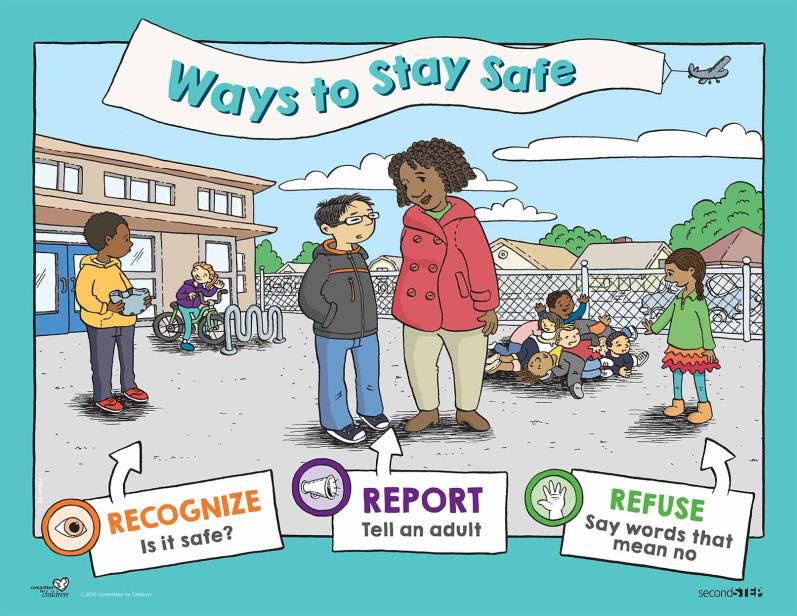
RECOGNISE IT – Don’t ignore it
REPORT IT – Tell a trusted adult
REFUSE IT – Try and stand up for yourself without being aggressive – do not be intimidated
Whom should you tell?
You should tell someone you feel comfortable talking to about what is happening to you, but if possible you should:
- Tell a friend, your Form Teacher, or another teacher. Your Form Teacher will then decide on the best thing to do to help you
- When you get home talk to a member of your family
- Call someone who is trained to listen to your problem, e.g. Childline 0800 1111
Then try to practise the following strategies:
- Stay calm and look as confident as you can
- Be firm and clear and look them in the eye and tell them to stop
- Move away from the situation as quickly as possible
- Remember bullying is persistent, not a one-off
Any child who reports a bullying incident to a member of staff will be fully supported, and any subsequent intimidation by another child(s) will be treated equally seriously.
What should the bully be helped to do?
If you are a bully, it can become criminal behaviour. If you don’t stop the police could be asked to take action. So:
- Think about the consequences to both yourself and the victim
- Think of the hurt that you are causing; imagine how it feels to be your victim
- Accept the help that you will be offered to face up to your problem
- When appropriate take the opportunity to apologise for your behaviour
What should a member of staff who sees or suspects bullying do?
Teachers must be alert to the potential for bullying. If a member of staff suspects that bullying is occurring, she/he should follow the procedure below:
- Notify the Form teacher (if applicable).
- Complete two Head’s Confidential Report – one for the potential victim and one for the potential bully. Remember to write everything down.
- Notify all relevant through the Staff Briefing as soon as possible to allow for a ‘vigilant watch’ to be put into place.
- A member of SLT will investigate the situation and will talk to the victim, the bully and, where necessary, other children including the class of the victim and the bully
- Notify parents when appropriate
Strategies for Support
- Be approachable for the victim/bully to talk freely
- Anonymity is essential for children speaking to teachers, but children must be aware that it is not always possible
- Give the victim support and advice – offer mediation
- Ask the child what they want you to do. How can you help them?
- Give the bully support and advice
- Recurring bullying always involves the Headmistress and the DSL or DDSLs who will invite the parents of the bully into school for a discussion. The Headmistress will take any disciplinary action where necessary. Depending on the severity of the incident this could take the form of the child on a report or regular supervision.
- Proof of severe, continued bullying where sanctions are ineffective could result in exclusion or permanent removal from school. It may also necessitate the intervention of outside agencies such as the police if the behaviour continues.
- We will advise children responsible for bullying that we will be checking to ensure that bullying stops.
We will keep records of incidents and record how we respond to them to enable patterns to be identified.A copy of the record will be kept in the files of the bullied and bully.
What should the victim’s friends do?
- Support the victim
- Stick up for your friend in front of the bully
- Persuade her/him to talk to a teacher or another trusted person
- You might feel you can ask the bully why she/he is behaving in this manner to your friend
- Friends might also be intimidated by the bully, so go to a teacher/trusted person together
What should the bully’s friends do?
- Do not join in
- Ask why she/he is bullying and make them think about their behaviour and the consequences
- Offer advice on how to change this behaviour
- Get the bully to look at the situation from the victim’s viewpoint
What should parents do if they suspect their child is being bullied?
- Speak firstly to the Form teacher/Class Teacher/Key Practitioner. If the Form Teacher is unable to resolve the situation, or if the seriousness of the situation requires it, please speak to a member of the SLT who will then take the appropriate action. If unable to resolve the situation, SLT will consult to the Headmistress
- Support your child and reassure them that the situation will be dealt with sensitively
- Give advice but do not overreact – encourage mediation where this is appropriate
What should parents do if they think that their child is bullying?
- Ask themselves and the bully why – encourage mediation where this is appropriate
- Contact the Form Teacher or a member of SLT
- Decide on appropriate sanctions
- Talk to your child about how hurtful and wrong bullying is
- Support our anti-bullying policy and procedures
- Help them to understand that physical threats and intimidation are criminal offences and help them to understand how things could get out of hand
Indecent Management
Newbridge Preparatory School will take firm and decisive action to deal with any incident of bullying/cyberbullying which is witnessed by or reported to any member of staff by parents, children or staff.
Post-incident responses for the victim:
When a member of staff receives information, either directly or indirectly, that a child may have been the victim of a bullying incident, this report will be taken seriously, investigated and written records kept. The incident may be investigated by the SLT.
Newbridge Preparatory School will offer a proactive, sympathetic and supportive response to children who are the victims of bullying. The exact nature of the response will be determined by the particular child’s individual needs and may include:
- Immediate action to stop the incident and secure the child’s safety
- Positive reinforcement that reporting the incident was the correct thing to do
- Reassurance that the victim is not responsible for the behaviour of the bully
- Strategies to prevent further incidents
- Sympathy and empathy
- Counselling
- Befriending
- Assertiveness training
- Extra supervision/monitoring
- Creation of a support group/buddy
- Peer mediation/peer mentoring
- Informing/involving parents
- Adult mediation between the perpetrator and the victim (provided this does not increase the victim’s vulnerability)
- Arrangements to review progress
Post-incident responses for the bully:
Newbridge Preparatory School takes bullying behaviour very seriously and will adopt a supportive, pragmatic, problem-solving approach to enable bullies to behave more acceptable. Newbridge Preparatory School understands that certain sanctions may not be appropriate in managing this problem, but the positive use of sanctions can be useful in demonstrating to bullies that their behaviour is unacceptable and encourages the promotion of positive change.
The School will respond to incidents of bullying behaviour proportionately – the more serious the cause for concern the more serious the response. When sanctions are felt to be necessary, they will be applied consistently and fairly. The Disciplinary sanctions will reflect the seriousness of an incident and convey a deterrent effect. These will be in line with the school Behaviour Policy.
Dealing with Child-on-Child Abuse by One or More Pupils
If a pupil reports Child-on-Child abuse from another pupil or pupils, which exceeds the remit of this ANTI-BULLYING POLICY the SAFEGUARDING/CHILD PROTECTION POLICY should be implemented. A bullying incident will be regarded as a child protection concern where there is reasonable cause to suspect that a child is suffering, or is likely to suffer, significant harm.
Monitoring and Review of the Bullying Strategy
The whole school community is made aware of ways of reporting incidents of bullying. Bullying is reported to a member of the school staff who will then report it to his or her line manager, and the appropriate action will be taken. Staff awareness is raised through training so that the principles of the school policy are understood. A central register of bullying incidents is retained in the Headmistress’s office and is reviewed by SLT to ensure the approach by the school is effective and enables any patterns to be identified.
Education
Throughout our broader curriculum, educational elements such as personal, social and health education (PSHEe), assemblies, projects, drama, stories, literature are used to:
- Raise awareness about bullying and our anti-bullying policy
- Increase understanding for victims and help build an anti-bullying ethos
- Teach children how constructively to manage their relationships with others
Role plays and stories are used to show what children can do to prevent bullying and to create an anti-bullying climate in the school. This takes place in form period and assemblies, PSHE and SMSC with a discussion of differences between people and the importance of avoiding prejudice-based language and making sure children are clear about the part they can play to prevent bullying, including when they find themselves as bystanders.
Newbridge Preparatory School uses our curriculum to reinforce these messages:
- All children have the right to feel happy, safe and included
- Children and staff have the right to work in an environment without harassment intimidation or fear
- All bullying, of any sort, is unacceptable
- Children and staff who experience bullying will be supported
Communication
Our Anti-Bullying Strategy is communicated to:
- Parents via our website
- Children via our education and curriculum
- Staff via Induction, staff meetings and training
Cyber Bullying
While Newbridge Preparatory does not allow electronic devices to be brought into school by children; we acknowledge that there is an increasing availability to children of electronic devices outside of school that give unrestricted access to the internet. Therefore cyber-bullying is covered under the school’s E-Safety Policy. In PSHEe and Computing the school considers online safety as part of both safeguarding and anti-bullying arrangements. Vigilance of teachers and parents have a part to play in the safeguarding and protection of pupils at school and children at home.
Conclusion
At Newbridge Preparatory School we do not accept that bullying is an inevitable part of school life. No-one should have to suffer bullying. It is up to all of us to take action when bullying happens, to us or others. Bullying will not be tolerated.
Further Sources of Information
Other departmental advice and guidance you may be interested in
Behaviour in Schools – September 2022
Mental health and Behaviour in Schools – November 2018
Counselling in schools a blueprint for the future: advice for school leaders and counsellors – February 2016
Keeping Children Safe in Education (KCSIE) 2024
Working together to safeguard children – Update July 2024
Working together to safeguard children – GOV.UK (www.gov.uk)
Specialist organisations
The following organisations provide support for schools and parents dealing with specific bullying issues including the social, mental or emotional effects caused by bullying.
The Anti-Bullying Alliance (ABA): Founded in 2002 by NSPCC and National Children’s
Bureau, the Anti-Bullying Alliance ABA) brings together over 100 organisations into one network to develop and share good practice across the whole range of bullying issues.
https://anti-bullyingalliance.org.uk/
The Diana Award: Anti-Bullying Ambassadors programme to empower young people to take responsibility for changing the attitudes and behaviour of their peers towards bullying. It will achieve this by identifying, training and supporting school anti-bullying ambassadors.
Kidscape: Charity established to prevent bullying and promote child protection providing advice for young people, professionals and parents about different types of bullying and how to tackle it. They also offer specialist training and support for school staff and assertiveness training for young people.
The BIG Award: The Bullying Intervention Group (BIG) offer a national scheme and award for schools to tackle bullying effectively.
https://www.bullyinginterventiongroup.org/big-award
Restorative Justice Council: Includes best practice guidance for practitioners
https://restorativejustice.org.uk/
Cyber-bullying and online safety
ChildNet International: Specialist resources for young people to raise awareness of online safety and how to protect themselves. The website specifically includes new cyberbullying guidance and a practical PSHE toolkit for schools.
Digizen: provides online safety information for educators, parents, carers and young people.
https://www.childnet.com/resources/looking-for-digizen/
Internet Matters: provides help to keep children safe in the digital world.
https://www.internetmatters.org
Think U Know: resources provided by Child Exploitation and Online Protection (CEOP) for children and young people, parents, carers and teachers.
The UK Council for Child Internet Safety (UKCCIS) has produced a range of resources for schools, colleges and parents about how to keep children safe online; this includes advice for schools and colleges on responding to incidents of ‘sexting.’
https://www.gov.uk/government/groups/uk-council-for-child-internet-safety-ukccis
LGBT
Barnardos: through its LGBTQ Hub, offers guidance to young people, parents and teachers on how to support LGBT students and tackle LGBT prejudice-based bullying
https://www.barnardos.org.uk/what-we-do/supporting-young-people/lgbtq
EACH: (Educational Action Challenging Homophobia): provides a national Freephone Actionline for targets of homophobic or transphobic bullying and training to schools on sexual orientation, gender identity matters and cyber homophobia.
Metro Charity: an equality and diversity charity, providing health, community and youth services across London, the South East, national and international projects. Metro works with anyone experiencing issues related to gender, sexuality, diversity or identity.
Proud Trust: helps young people empower themselves to make a positive change for themselves and their communities through youth groups, peer support, delivering of training and events, campaigns, undertaking research and creating resources.
https://www.theproudtrust.org/
Schools Out: Offers practical advice, resources (including lesson plans) and training to schools on LGBT equality in education.
http://www.schools-out.org.uk/
Stonewall: An LGB equality organisation with considerable expertise in LGB bullying in schools, a dedicated youth site, resources for schools, and specialist training for teachers.
https://www.stonewall.org.uk/schools-colleges
SEND
Mencap: Represents people with learning disabilities, specific advice and information for people who work with children and young people.
Changing Faces: Provide online resources and training to schools on bullying because of physical difference.
https://www.changingfaces.org.uk/
Cyberbullying and children and young people with SEN and disabilities: Advice provided by the Anti-Bullying Alliance on developing effective anti-bullying practice.
Anti-bullying Alliance SEND programme of resources: Advice provided by the Anti-bullying
Alliance for school staff and parents on issues related to SEND and bullying.
Information, Advice and Support Service Network: Every Local area has information, advice and support service, providing information, advice and support to disabled children and young people, and those with SEN, and their parents.
Mental health
MindEd: Provides a free online training tool for adults that is also available to schools. It can be used to help school staff learn more about children and young people’s mental health problems. It provides simple, clear guidance on mental health and includes information on identifying, understanding and supporting children who are bullied.
PSHE Association – guidance and lesson plans on improving the teaching of mental health
Issues
https://pshe-association.org.uk/
Race, religion and nationality
Anne Frank Trust: Runs a schools project to teach young people about Anne Frank and the
Holocaust, the consequences of unchecked prejudice and discrimination, and cultural diversity.
Educate Against Hate: provides teachers, parents and school leaders practical advice and information on protecting children from extremism and radicalisation.
https://educateagainsthate.com/
Show Racism the Red Card: Provide resources and workshops for schools to educate young people, often using the high profile of football, about racism.
Kick It Out: Uses the appeal of football to educate young people about racism and provide education packs for schools.
Tell MAMA: Measuring Anti-Muslim Attacks (MAMA) allows people from across England to report any form of Anti-Muslim abuse, MAMA can also refer victims for support through partner agencies.
Anti-Muslim Hatred Working Group: Independent members of this group are representatives from the Muslim community and will assist and advice on all relevant issues.
Please note that internal servers may block access to some of these sites. Schools wishing to access these materials may need to adjust their settings.
https://www.gov.uk/government/groups/anti-muslim-hatred-working-group
Sexual harassment and sexual bullying
Ending Violence Against Women and Girls (EVAW): A Guide for Schools. This guide from the End Violence Against Women Coalition sets out the different forms of abuse to support
education staff to understand violence and abuse of girls, warning signs to look for, and how to get your whole school working towards preventing abuse. (2016-2020)
Disrespect No Body: a Home Office-led campaign which helps young people understand what a healthy relationship is. This website includes teaching materials to be used in the classroom.
https://www.gov.uk/government/collections/disrespect-nobody-campaign
Anti-bullying Alliance: advice for school staff and professionals about developing effective anti-bullying practice concerning sexual bullying.
https://anti-bullyingalliance.org.uk/
Written 04/04/2013 – SAF
Reviewed 04/04/2014 – SAF
Reviewed 16/12/2015 – SAF
Reviewed 17/01/2017 – SLT
Reviewed 15/01/2019 – SAF
Reviewed 26/11/2020 – SAF
10/09/2022 – Reviewed – SAF
20/09/2022 – Updated to reflect current practice (logs) and live links – SAF
13/11/2023 – Updated by SAF
10/09/2024 – Updated by NBB
23/07/2025 – Reviewed by NBB
23/07/2026 – Reviewed by NBB