
Newbridge Preparatory School believes that children flourish best when their personal, social and emotional needs are met and where there are clear and developmentally appropriate expectations for their behaviour. We think that praise should always be used as the greatest motivator. It is a primary aim of our school that every member of the school community feels valued and respected and that each person is treated fairly and well. This policy is intended to provide guidelines for high standards of behaviour in school. As such, it is intended to promote a learning environment in which all children can realise their potential. It is designed to ensure that positive behaviour is regarded as the norm and that it will be rewarded.
Behaviour Policy
This Policy applies to the whole school including the EYFS.
Newbridge Preparatory School implements this behaviour management policy and procedures.
Mrs Burrows-Berry, Mrs Griffiths and Mr Goulding are responsible for behaviour management at Newbridge Preparatory School. All have the necessary skills to advise other staff on behavioural issues and can access expert advice from Wolverhampton LEA if necessary.
This policy is drawn up in line with the Non Statutory advice Behaviour in Schools – September 2022:
Statement Of Intent
Aims
We aim:
- To teach children to behave in socially acceptable ways and to understand the needs and rights of others
- To develop a Behaviour Policy, supported and followed by the whole school community – parents, teachers, children and Directors – based on a sense of community and shared values
- To foster a caring, family atmosphere, in which teaching and learning can take place in a safe and happy environment
- To teach moral values and attitudes as well as knowledge and skills through the School Curriculum. (This will promote responsible behaviour, self-discipline, self-respect and respect for other people and property)
- To resolve behavioural problems in a caring and sympathetic manner
OUR SCHOOL RULES AND CODE OF CONDUCT
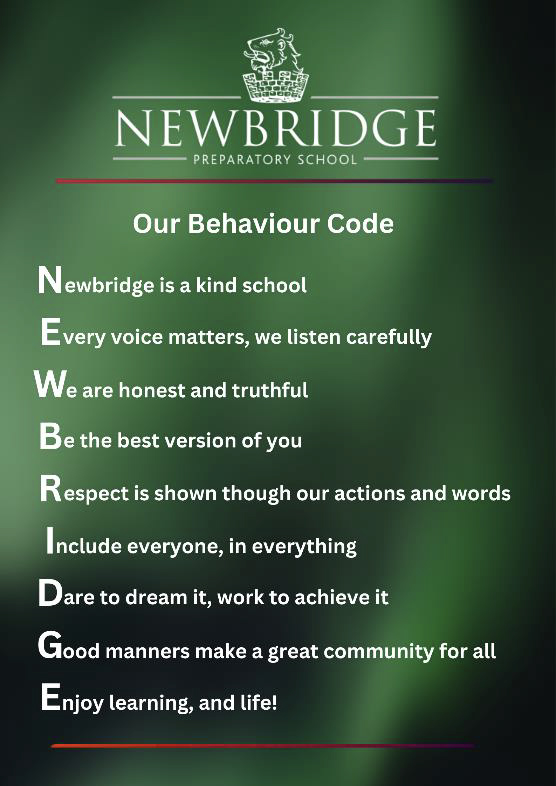
We believe that discipline originates from mutual respect. Our approach is to praise children being good and reward them with encouragement. The staff and pupils worked together to create our Newbridge Behaviour Code.
We wish our children to show independence and a sense of responsibility. Our ultimate aim is to develop children’s self-discipline so that they behave with care, courtesy and good manners, showing respect for other people and property.
Copies of the School Rules are on the School’s website and in the Parent Handbook and may change from time to time. Parents and Guardians agree, when signing the Parent Contract, that their child will comply with the School Rules and that they will undertake to support the authority of the Headmistress in enforcing the School Rules in a fair manner that is designed to safeguard the welfare of the School community as a whole.
Unacceptable anti-social behaviour is not tolerated. Parents are informed of a serious breach of good behaviour, and joint action is taken in the best interests of the child concerned.
Ethos
The purpose of this policy is to promote ‘good behaviour’ (which includes guidelines on rewards and sanctions) is to promote a positive ethos, placing the emphasis of the school on achievement and effort and celebrating success. It is vital that praise and rewards have a considerable focus within the school, i.e. they are a prominent feature, so that children will achieve recognition for a positive contribution to school life, and others will see what is recognised as exemplary behaviour. The attention of the school should not be focused excessively on those whose academic work is outstanding; all children should feel valued by the school, and a formalised system of rewards will go some way to achieving this.
It is expected that proper standards of behaviour will be encouraged through the consistent application of the policy, supported by a balanced combination of reward and sanctions within a constructive school ethos.
Procedures
The person responsible for behaviour management issues in EYFS and Lower School is Mrs Griffiths and in Upper School is Mr Goulding, both working closely with Mrs Richards and Mrs Southall (SENDCos). Members of staff are encouraged to ask for advice or guidance.
The Headmistress, Mrs N. Burrows-Berry, has overall responsibility for supporting issues concerning behaviour
- We require all staff, volunteers and students on placement, to provide a positive model of decorum by treating children, parents and one another with friendliness, care and courtesy
- We familiarise new staff and volunteers with our Behaviour Policy and its guidelines for behaviour during induction
- We expect all members of our setting, children, parents, staff, volunteers and students to keep to the guidelines, requiring these to be applied consistently
- We work in partnership with children’s parents. Parents are informed regularly about their children’s behaviour by their key person or form teacher
- We work with parents to address recurring inconsiderate behaviour if necessary keeping observation records to help us to understand the cause and to decide jointly how to respond appropriately. Observation Records may be kept on the Day Book Log (Engage). This may be kept in a different format if advised to do so by Mrs Richards, Mrs Southall (SENDCos) or the Headmistress.
Promoting Positive Behaviour
We aim to use positive pro-active strategies to promote positive behaviour in children and set these strategies within our programme for personal, social and emotional development. These include:
- Supporting each child in developing self-esteem, confidence and feelings of competence
- Assisting each child in developing a sense of belonging in our group, so that they feel valued and welcome
- Acknowledging considerate behaviour such as kindness and willingness to share
- Recognising children’s considerate behaviour towards another who is hurt or upset
- Helping older children set the group’s guidelines for polite conduct
- Providing activities and games that encourage co-operation and working together
- Ensuring that there are enough resources and sufficient activities available so that children are meaningfully occupied without the need for unnecessary conflict over sharing and waiting for turns
- Avoiding creating situations in which children receive adult attention only in return for inconsiderate behaviour
- Using ‘Time to Think’ procedures for children in Key Stage 1 and Key Stage 2 to reflect on their action for short periods. (General Guide: No longer than one minute for each year of their age)
- In EYFS, asking a child to remain close to a member of staff for a short period until the current issue is resolved
Consistent Applications Of The Policy
Members of staff aim to be consistent in their application of the policy and show their support by:
- Being positive (avoid confrontation, e.g. use of a loud voice; negative body language)
- Having high expectations of good behaviour for learning and enjoyment of school life
- Knowing children as individuals
- Listening to children and getting the facts
- Teaching and supporting children to achieve the aims and values of this policy – through the PSHE Curriculum but also, through the everyday life of the classroom
- Consistently encouraging and praising children concerning good behaviour
- Giving attention to good behaviour and rewarding it
- Telling others, including parents about children’s good behaviour
- Helping children to put things right
- Providing opportunities for co-operative learning and play
- Class teachers/Practitioners being responsible for making sure that detailed records on Engage Day Book are kept about rewards, but also around the triggers, sanctions and conversations with parents following poor behaviour. This record should be made by the first person dealing with the event and include detail about consequences or rewards given. All staff should lead on behaviour. Any follow up information should be recorded by the relevant member of staff.
STAFF/PRACTITIONERS SHOULD NOT:
- Send children out of the room by themselves (Year 5 and 6 may use the Learning Enhancement Room which is situated between their rooms)
- Use the ‘Time Out’ procedures for children under five years of age. EYFS children need to be supported with their emotions at critical times not isolated
- Use or threaten to use physical punishment, such as smacking or shaking
- Use techniques intended to single out and humiliate individual children, such as ridicule or sarcasm
- Remove toys or activities that are the focus of a conflict, as a ‘punishment’ or means of ‘teaching children to share’, without discussion or expectation
- Use physical restraint, such as holding, unless to prevent bodily injury to children or adults or severe damage to property
- Shout or raise our voices
CORPORAL PUNISHMENT
The law forbids a teacher to use any degree of physical contact which is deliberately intended to punish a pupil, or which is primarily intended to cause pain or injury or humiliation. At Newbridge Preparatory School, corporal punishment is not allowed.
- Members of staff at Newbridge Preparatory School must not give corporal punishment to a child
- Members of team must not threaten corporal punishment, and must not use or threaten any punishment which could adversely affect a child’s well-being
- Newbridge Preparatory School will take all reasonable steps to ensure that corporal punishment is not given by any person who cares for or is in regular contact with a child
A member of staff will not be taken to have used corporal punishment (and therefore will not have committed an offence), where physical intervention was used to avert immediate danger of personal injury to any person (including the child); or to manage a child’s behaviour if necessary.
USE OF REASONABLE FORCE (Also see SAFE TOUCH POLICY)
Like all schools, we reserve the right for our staff to use reasonable force to control or restrain a pupil in specific circumstances. Teachers and any other member of staff authorised by the Headmistress have a statutory power to use “such force as is reasonable in the circumstances to prevent a pupil from doing or continuing to do” any of the following:
- Committing any offence;
- Causing personal injury to any person (including the pupil themselves);
- Causing damage to the property of any person (including the pupil themselves); and
- Prejudicing the maintenance of good order and discipline at the School.
- The use of reasonable force means using no more force than needed and will always depend on the circumstances of the case.
- The decision on whether or not to intervene will be a professional judgement of the member of staff concerned, and any force used must always be reasonable and proportionate to the circumstances and seriousness of the behaviour, and must take into account any disability, certain health conditions or SEND that the pupil may have.
The factors that must be considered in reaching a judgement as to whether the use of physical restraint is appropriate that include:
- The seriousness of the incident, assessed by the effect of the injury, damage or disorder that is likely to result if force is not used;
- The chances of achieving the desired result by other means; and
- The relative risks associated with physical intervention compared with using other strategies.
- Every member of staff will inform the Headmistress immediately after s/he has needed to restrain a pupil physically and complete a Reasonable Force Log Template (found in Safe Touch Policy).
We will always inform a parent when it has been necessary to use physical restraint on their child, and invite them to the School, so that we can, if necessary, agree a plan for managing their child’s behaviour. Parents of EYFS pupils will be informed of the incident on the same day or as soon as is reasonably practicable.
Reasonable Force Training
Staff training is available to those who would like it, via The TES Develop Portal:
- Use of Reasonable Force In Schools
Whilst the use of reasonable force in schools should be seen as a last resort in handling a serious incident, the training explains when and how it may be used. The course covers what reasonable force means and who can use it, and details what happens in situations where it has been used.
The main objectives for this course are:
- Understand what reasonable force is and who can use it.
- Learn when reasonable force can be used.
- Understand what happens in situations when reasonable force has been used.
- Identify good practice about incidents involving reasonable force.
BEHAVIOUR ETHOS
The underlying ethos in the Behaviour Policy and procedures used with the children is about choice. Children are encouraged to make ‘good choices’, and if they do not, then they should be given a ‘reminder’ to modify their behaviour.
Our experience shows that the ethos of the School is enhanced by listening to our pupils and by encouraging constructive suggestions from them, in assemblies, and during form time, Personal, Social and Health Education (PSHE) lessons, project work, drama activities, stories and via the School Council, which meets regularly.
INCENTIVE AND REWARD SCHEME
A primary intent of this policy is to encourage children to exhibit good behaviour; reinforced with a system of praise and reward for all children. Through the Newbridge Preparatory School scheme, based on a range of differentiated systems, children can be rewarded for academic and non-academic achievements, for effort and for being caring, and for all aspects of good work and behaviour. Rewards include stickers and House Points and also, each class teacher gives oral or written praise. Most children respond to a positive approach where their efforts are acknowledged and make considerable efforts to improve their work and, when necessary, their behaviour. By using a positive system of rewards and reinforcing good practice, Newbridge Preparatory School fosters children’s positive self-esteem. These include:
- Stickers
- Certificates
- House point systems
- Rewarding good behaviour when the child DOES NOT EXPECT IT
- Commenting on a child’s etiquette towards other children/other classes
- Sharing achievements in Assembly or through the Newsletter
INCENTIVE STICKERS/HOUSE POINTS
The children collect stickers (EYFS) and House Points (Year 1 onwards) either in their books or on themselves (particularly in EYFS and Key Stage 1).
Incentive Stickers are given for good pieces of work or behaviour. In academic subjects, members of staff should reward commitment and perseverance at all levels of ability. House Points should not be rewarded just for getting ‘everything’ correct. House Points can also be awarded for completing and returning homework. House points are also used to reward all children who have tried hard with their weekly spellings – and not just those children who achieve full marks.
Stickers are provided for the staff by the school. Mrs Walker keeps stocks of House Point Stickers, and these can be requested through the Stationery Order system. (Purchased from http://www.primaryteaching.co.uk/)
- House Points and House Point Stickers for Years 1 and 2.
- House Point Tokens for Year 3, 4, 5 and 6.
In Years 1 and 2, a record of attainment is kept by children on their own house point cards, which are stamped when a house point is awarded. Every Friday these are counted by the Form Teachers in Registration and updated on the spreadsheet on “Staff Share”.
In Upper School, house points are awarded by a member of staff, for whatever reason, as a House Point Token or a House Point Slip. The girls in Upper School collect these House Points Tokens or Slips in their top blazer pocket throughout the week. Every Friday these are counted by the Form Teachers in Registration and updated on the spreadsheet on “Staff Share”. This is overseen by Mr Goulding.
Additionally, a variety of more personal incentive stickers can also be used as additional encouragement by teachers and EYFS Practitioners. (Sweets should not be used as a reward).
HOUSE POINT BADGES
Once the House Points are collated for each child Mr Goulding and the House Captains calculate the house point totals for their house each week. These are then announced in the Form Honours Assembly on a Monday. Also announced is the individual gaining the most house points for their house in the previous week. The house mascot is awarded to that child to keep in their form room for the remainder of the week.
Additionally, as a further incentive, enamel badges are presented to individuals who reach set totals of house points across the year for Upper School and termly for Lower School. The ultimate incentive in Upper School is the earning the ‘crown jewels’: Bronze (40), Silver (80), Gold (120), Diamond (160), Platinum (200) and the Crown Jewels (300). In Lower School, children aim to earn a Gold Happy Face badge by the end of each term: Bronze (20), Silver (400 and Gold (60).
Upper School:
| Badge | Number of points during whole academic year |
|---|---|
| Bronze | 40 |
| Silver | 80 |
| Gold | 120 |
| Diamond | 160 |
| Platinum | 200 |
| Crown | 300 |
Lower School:
| Badge | Number of points during term |
|---|---|
| Bronze | 20 |
| Silver | 40 |
| Gold | 60 |
FORM HONOURS CERTIFICATES
Form Honours Certificates place a strong emphasis on individual growth and self-improvement. They celebrate the unique journey of each child, recognising their personal accomplishments and progress, regardless of how they compare to their peers. This approach fosters a supportive and inclusive learning environment, where children are motivated to strive for their personal best, knowing that their efforts are valued and acknowledged. By focusing on self-measured success, Form Honours not only recognise academic achievements but also promote character development, self-esteem, and a genuine love for learning. They are designed to empower pupils to become their best selves, both academically and personally. All children will be awarded a certificate each term. Form Honours Certificates are kept with class teachers who write the certificates each week. Special Form Honours can be awarded to the whole class.
EARLY YEARS FOUNDATION STAGE
- When children aged 3 and under behave in inconsiderate ways, we recognise that strategies for supporting them will need to be developmentally appropriate and differ from those for older children
- We appreciate those very young children are unable to regulate their own emotions, such as fear, anger or distress, and require sensitive adults to help them learn to do this
- Common inconsiderate or hurtful behaviour of young children include tantrums, biting or fighting
- Staff are calm and patient, offering comfort to intense emotions, helping children to manage their feelings and talk about them, to help resolve issues and promote understanding
POSITIVE INTERVENTION IN EYFS AND KEY STAGE 1
We make a distinction between three kinds of behaviour that require support or intervention to achieve the considerate and socially acceptable behaviour that we expect of children according to their age and developmental maturity or whether they have any particular educational need. These behaviours are:
- Inconsiderate behaviour
- Hurtful behaviour
- Bullying
INCONSIDERATE BEHAVIOUR IN THE EYFS AND KEY STAGE 1
Inconsiderate behaviour in the EYFS and Key Stage 1 includes behaviour such as taking toys from another child, not waiting for a turn, pushing, being uncooperative and disrupting a game. In EYFS, these behaviours are characterised by developmental immaturity, whereby children are not at the stage where they can manage frustration or anger themselves, they may not have the language to express themselves, or may not understand and be able to keep to social rules. These are all common behaviours that a child displays on their journey to develop socially acceptable forms, particularly of dealing with conflict. We regard the child to be a learner of what is acceptable and in need of support, explanation, encouragement, positive modelling and guidance, just as in learning any other skill.
STRATEGIES FOR INCONSIDERATE BEHAVIOUR IN THE EYFS AND KEY STAGE 1
We require all staff, volunteers and students to use positive procedures for handling any inconsiderate behaviour, by helping children find solutions in ways which are appropriate for the child’s age and stage of development. Such solutions might include, for example, acknowledgement of feelings, an explanation as to what was not acceptable and supporting children to gain control of their emotions so that they can learn a more appropriate response. Staff offer comfort to both children in a dispute and encourage them to find a solution to their problem. When children behave in inconsiderate ways, we help them to understand the outcomes of their action and support them in learning how to cope more appropriately. We praise children for their efforts and achievements in resolving a dispute or learning a social skill such as waiting for their turn. For repeated behaviour or behaviour of this nature concerning older KS1 children, staff may decide to offer thinking time, further discussion with the child and possibly a conversation with a parent if appropriate.
HURTFUL BEHAVIOUR IN THE EYFS AND KEY STAGE 1
We take dangerous behaviour very seriously. Most children will at some stage hurt or say something hurtful to another child, especially if their emotions are high at the time, but it is not helpful to label this behaviour as ‘bullying’, even if the action is worryingly aggressive. For most children under seven, hurtful behaviour is momentary, spontaneous and often without awareness or thought for the feelings of the person whom they have hurt. Some children may engage in harmful conduct because they are deeply unhappy and they require support and care. However, dangerous behaviour has an impact on the child at the receiving end which is significant, and this is also taken into consideration when responding to incidents of hurtful behaviour.
STRATEGIES FOR HURTFUL BEHAVIOUR IN THE EYFS AND KEY STAGE 1
We recognise that young children behave in hurtful ways towards others because they have not yet developed the means to manage intense feelings that sometimes overwhelm them. We will help children to manage these feelings as the means to do this for themselves is still underdeveloped in young children. We understand that self-regulation of intense emotions, especially of anger, happens when the brain has developed neurological systems to manage the physiological processes that take place when ‘triggers’ activate responses of anger or fear. Therefore we help this process by offering support, calming the child who is angry as well as the one who has been hurt by the behaviour. By helping the child to return to a normal state, we are supporting the brain to develop the physiological response system that will help them, to be able to manage his or her feelings.
In the EYFS, our way of responding to pre-verbal children is to calm them through holding and cuddling. Verbal children will also react to physical touch to calm them down, but we offer them an explanation and discuss the incident with them to their level of understanding.
In Key Stage 1, we explain and discuss the event with them. We recognise that young children require help in understanding the range of feelings experienced. We help children identify their feelings by naming them and assisting the children to express them, making a connection verbally between the event and the feeling. ‘Adam took your car, didn’t he, and you were enjoying playing with it. You didn’t like it when he took it, did you? It made you feel angry, didn’t it, and you hit him’. We help young children learn to empathise with others, understanding that they have feelings too and that their actions impact on others’ feelings. ‘When you hit Adam, it hurt him, and he didn’t like that, and it made him cry’. We help young children develop pro-social behaviour, such as resolving the conflict over who has the toy. ‘I can see you are feeling better now and Adam isn’t crying any more. Let’s see if we can be friends and find another car, so you can both play with one.’ We are aware that the same problem may happen over and over before skills such as sharing and turn-taking develop. For this development to take place, children will need repeated experiences with problem-solving, supported by patient adults and clear boundaries.
We support social skills through modelling behaviour, through activities, drama and stories. We build self-esteem and confidence in children, recognising their emotional needs through close and committed relationships with them. We help a child to understand the effect that their dangerous behaviour has had on another child; we do not force children to say sorry but do encourage this, where it is clear that they are genuinely sorry and wish to show this to the person they have hurt.
Pupils may be supported through the use of some quiet reflection time, this may take place immediately or at an appropriate time such as during break or lunch time. This will be a short period of time providing time for thought about behaviours and then some discussion with an adult. If the behaviour is deemed significant, a discussion with the parent at the end of the day will take place. This will be done by the form teacher.
PROBLEMATIC HURTFUL BEHAVIOUR IN THE EYFS AND KEY STAGE 1
We work with parents to identify the cause and find a solution together. The main reasons for very young children to engage in excessive hurtful behaviour are that:
- They do not feel securely attached to someone who can interpret and meet their needs. This may be in the home, and it may also be in Newbridge Preparatory School
- The child is exposed to levels of aggressive behaviour at home and may be at risk emotionally, or may be experiencing child abuse
- The child has a developmental condition that affects how they behave
In cases of hurtful behaviours, such as racial or other abuse, we make clear immediately the unacceptability of the action and attitudes, using explanations rather than personal blame.
Hurtful behaviour incidents that give cause for concern are recorded on a ‘Confidential Report to the Headmistress’ log and in Day Book Engage Logs. These forms are placed in the child’s personnel file. In the first instance, the child’s parent is informed on the same day or following morning, either in person/by phone, by the child’s teacher or key practitioner.
FANTASY AGGRESSION IN EYFS AND KEY STAGE 1
Young children often engage in play that has dynamic themes, such as superhero and weapon play. These are often linked to television programmes or computers (PlayStation, X-Box, DS, and PSP) games. Some children appear pre-occupied with these themes, but their behaviour is not necessarily a precursor to bullying, although it may be inconsiderate, or even hurtful at times and may need addressing using the strategies as above. We recognise that fantasy play also contains many violently dramatic procedures – blowing up, shooting etc. and that themes often refer to ‘goodies and baddies’ and as such offer opportunities for us to explore concepts of right and wrong and alternatives to blowing up or shooting. We can tune in to the content of the play, perhaps to suggest alternative strategies for heroes and heroines, making the most of ‘teachable moments’ to encourage empathy and lateral thinking to explore alternative scenarios and strategies for conflict resolution.
THE ENABLING ENVIRONMENT IN EYFS
In Pre-Nursery, practitioners use tone of voice to express their disapproval of unacceptable actions. Positive reinforcement is promoted by adult role-play. Distracting a child to another activity or toy is often used.
In Nursery, the book ‘Colours Monsters’ is used generally to ask how children are feeling. There are 7 spoons with painted characters to represent different emotions. Children can access these at any time to express their emotion or mood. ‘Thinking time’ appropriate to the age of the child is also prompted.
In the Reception classroom, a ‘self-regulation station’ is available with resources such as stress balls, a ‘pop-it’ toy, mindfulness colourings, to help children calm themselves down. Children may also be prompted to have some ‘thinking time’ to reflect upon their actions. This is a process of offering support by spending time with an adult who will help to calm the child who is angry and then talk about their actions. (EYFS children need to be supported with their emotions at critical times not isolated.)
SPECIAL EDUCATIONAL NEEDS
A small minority of children need ‘additional and different’ responses. Children with additional needs may be children with identified behaviour needs or children who through family circumstances require additional adult support to follow the behaviour policy. These children may need specific responses identified through their IEPs, or determined by school staff. All staff will be made aware of who these children are. This differentiated approach should have clear targets, rewards and sanctions, but the child may need adult support to achieve them. These programs should be drawn up in consultation with Mrs Richards or Mrs Southall (SENDCos).
KEY STAGE 1 AND KEY STAGE 2
The school has many rules as a means of promoting good relationships so that children can work together with the common purpose of helping everyone to learn. It is the responsibility of the class teacher to ensure that the rules are kept in their class and that their class behaves responsibly. The class teacher treats each child fairly and enforces the rules consistently. The teacher treats all children in their class with respect and understanding.
Classroom management and teaching methods have a significant influence on children’s behaviour. The classroom environment gives explicit messages to the children about the extent to which they and their efforts are valued. Relationships between teacher and children, strategies for encouraging good behaviour, arrangements of furniture, access to resources and classroom displays all have a bearing on the way children behave.
Classrooms should be organised to develop independence and personal initiative such as ensuring children have access to a Help Desk. Furniture should be arranged to provide an environment conducive to on-task behaviour. Materials and resources should be arranged to aid accessibility and reduce uncertainty and disruption. Displays should help develop self-esteem by demonstrating the value of every individual’s contribution, and overall the classroom should provide a welcoming environment.
Teaching methods should encourage enthusiasm and active participation for all. Lessons should aim to develop the skills, knowledge and understanding which will enable the children to work and play in co-operation with others. Praise should be used to encourage good behaviour as well as good work. Criticism should be a discreet matter between teacher and child to avoid resentment.
The following sanctions are used to discourage poor behaviour, to monitor children and to encourage improvement. Each sanction is employed appropriately for each situation:
- The class teacher will give the child eye contact and communicate the appropriate message calmly, firmly and clearly
- The class teacher will give the child a firm reminder about the school behaviour expectations. Asking if the child has made “good choices” and encouraging him/her to take the appropriate choice and responsibility for their actions
- If the child persists with the behaviour, the child will be given a verbal warning of consequences if they persist
- The child will be given “Time to Think” in their class for up to five minutes of reflection. ‘Time to Think’ within the classroom is to reflect upon actions, e.g. moved if on carpet or transferred to another table if working, sit by a teacher or sit on own
- Withdrawing playtime or part thereof. The class teacher meets with the pupil in which behaviour is discussed at playtime
- KS2 yellow reminder slip MINOR (minus one house point) if a member of staff deems it appropriate (e.g. no homework with parent signature / no music diary when given reasonable amounts of warnings). Minor Reminders should be handed into Mr Goulding by the pupil and parents must be informed via the Homework Diary or an email.
- Mr Goulding will monitor frequency of these. Three in one week will result in an orange MODERATE slip being issued and a phone call home by the Form Tutor
These sanctions would follow if more severe or repeated behaviours occur:
- Orange MODERATE reminder slip (minus three house points) for more concerning or repeated behaviour
- Red MAJOR reminder slip (minus five house points) for severe or continued repeated behaviour
A MAJOR slip also involves spending a playtime/breaktime to reflect and fill in a Reflection Sheet:
Download Reflection Sheet Here
- A Day Book Entry should be completed by the member of staff who first dealt with the MODERATE or MAJOR incident. Any subsequent notes should be added by the appropriate individual.
- Mr Goulding or Mrs Griffiths meets with the child and discusses reasons for action and ways forward.
- MODERATE and MAJOR slips must be referred to Mrs Griffiths or Mr Goulding. A phone call must be made to parents by Mr Goulding or Mrs Griffiths to inform parents that a sanction has been issued.
- Strategies are discussed and agreed by both parties (SENDCo involved if appropriate)
- If serious behaviour persists, the Headmistress writes a letter inviting the parents into the school. Plans are reviewed and approved by both parties (SENDCo involved if appropriate)
- Behaviour/Effort Reports are introduced to monitor behaviour/effort and investigate any trends/patterns that occur. The SENDCo will work with a member of staff to design an appropriate report.
- Exclusion Procedures for ‘Serious Misbehaviour’
KEY STAGE 1 AND KEY STAGE 2 – PLAYGROUND BEHAVIOUR
If school rules are broken at playtimes and lunchtimes, the behaviour is discussed with the child, and they are given a warning if required. If they disregard the advice, they are asked to stand by the member of staff for no more than 5 minutes.
Children are also asked to spend time by an adult they:
- Are rude to another child or adult
- Hurt other children deliberately
- Go inside when not allowed
- Damage equipment or plants/bushes
- Spoil other children’s games deliberately
At other times, children have an option to decide to go over to the quiet area if they want to think about how they are feeling or would like some advice from an adult. Staff on duty will then intervene and discuss with the child.
Any serious behaviour incidents, e.g. fighting, bullying, child-on-child abuse or racist name calling are reported to The Headmistress of Newbridge Preparatory School and could result in missed playtimes, a reflection sheet and possible exclusion from lunch playtime. However, members of staff are asked to collect as much information about the incident as possible – asking the child ‘Why?’ or ‘How were you feeling?’ As this can be a handy tool for understanding the feelings which triggered the behaviour. A DAY BOOK LOG should be filled in by the person first involved, updated by those concerned and a discussion should take place between form tutor and parent, unless serious enough to be dealt with by Mrs Goulding, Mrs Griffiths or Mrs Burrows-Berry.
If a child is regularly spending time in the quiet area or friendship bench then contact will be made, by the form tutor, with parents and a discussion will take place to decide and put in place strategies to help the child successfully integrate during this time.
MANAGING PUPIL TRANSITION THROUGHOUT KEYSTAGE
We carefully manage the transition of the children, not only from EYFS through to Key Stage One and Key Stage Two but also in preparing children for their senior school placement in Year Seven. A particular strength at Newbridge Preparatory School is the relationship staff develop with the children and families. Children always have transition sessions with their new class and teacher (Move-Up Morning), and we hold handover transition meetings at every move to enable clear communication for staff working with children. Because our staff team is in constant contact, any specific pupil support systems or strategies are seamlessly integrated as each child moves through the school to ensure consistency in their behaviour management.
We are especially careful in ensuring that transitions for children with SEND are fully prepared at each stage both internally and externally. We are continually building relationships with senior schools and children are encouraged to attend taster days and visit prospective new schools. The Year 6 teacher also liaises with the Heads of Year Seven to ensure a smooth transition for the children. Not only are children prepared for the academic change of moving to secondary school, but also the social side through the Jigsaw Programme.
MALICIOUS ACCUSATIONS AGAINST STAFF
If a pupil is found to have made a malicious accusation against a member of staff which has been determined to be unfounded, the school will refer the matter to Children’s Social Care to decide whether the pupil concerned is in need of services or support. On the rare occasions where it can be proved that the allegation has deliberately been invented or is malicious, the Headmistress, Mrs N Burrows-Berry, will temporarily or permanently exclude the pupil. Malicious accusations against our staff are not acceptable and are taken very seriously. Newbridge Preparatory School takes disciplinary action against pupils who are found to have made malicious allegations against a team which is necessary, may include exclusions.
The School has a bespoke Prohibited and Unauthorised Items Policy
SEARCHING
The School reserves the right to search pupils and their possessions.
The Headmistress, or a member of staff authorised by the Headmistress, may search a pupil provided there is another staff member present as a witness. The School does not conduct intimate searches and only a pupil’s outer clothing (for example coats, hats, shoes, gloves and scarves) will be removed to facilitate a search, but a pupil will first be given the opportunity to ’empty their pockets’ and to disclose anything that they should not have in school.
The School will always consider the age of the child to be searched and any SEND or vulnerabilities (including certain health conditions) the child may have before conducting the search to decide whether any additional precautions or adjustments are needed, in accordance with the School’s Safeguarding Policy.
The consent of a pupil will usually be obtained before conducting a search unless the Headmistress (or authorised member of staff) reasonably suspects that the pupil has in his/her possession an item that has been, or is likely to be, used to commit an offence, or to cause personal injury to any person (including the pupil being searched), or cause damage to property, or the pupil has, or is reasonably suspected to have in his/her possession any of the following items:
- Knives;
- Weapons;
- Alcohol;
- Illegal drugs;
- Stolen items;
- Tobacco and cigarette papers;
- Fireworks;
- Pornographic or offensive images; or
- Any item banned by the School Rules (including electronic devices).
Where a member of staff reasonably believes that there is a risk of serious harm to any person (including to the pupil being searched) if the search is not carried out immediately, the Headmistress (or authorised member of staff) is permitted to carry out a search of a pupil of the opposite sex. The Head (or authorised member of staff) is also permitted to undertake a search in this circumstance without a witness present only where it is not practical to summon another member of staff.
The School will inform the pupil’s parents of any search conducted after the event, particularly where alcohol, illegal drugs or potentially harmful substances have been found as a result of the search. The parent’s prior consent to undertake a search is not required.
The School will keep a record of all searches carried out, including the results of any search, and the actions taken following that search.
CONFISCATION
- A member of staff carrying out a search may seize any item that they have reasonable grounds for suspecting is a prohibited item or may be evidence in relation to an offence.
- Where a search identifies alcohol, tobacco or cigarettes, or fireworks they may be retained or disposed of by the member of staff but will not be returned to the pupil.
- Controlled drugs will be delivered to the Police as soon as reasonably practicable but may be disposed of if the member of staff considers there is good reason to do so. Substances that are not believed to be controlled drugs however, but that are believed to be harmful or detrimental to good order or discipline, may be confiscated by a member of staff. If the School is uncertain as to the legal status of a substance it will be treated as if it is controlled.
- In respect of weapons, or items that are believed to be evidence of an offence, these will be passed to the Police as soon as possible. Stolen items will also be delivered to the Police, but may instead be returned to the rightful owner, if there is good reason to do so.
- Where a search identifies an item banned under the School Rules, the member of staff conducting the search should take into account all relevant circumstances and use their professional judgement to determine whether the item should be returned to its owner, retained by the School or disposed of.
Electronic devices
- Where an electronic device is found during a search and that device is prohibited by the School Rules, or where the member of staff undertaking the search reasonably suspects that the device has been, or is likely to be used to commit an offence or cause personal injury or damage to property, the School may examine relevant data or files on the device, where there is good reason to do so. Parental consent to search through the electronic devices is not required but they will be informed after the event unless doing so presents a further risk to any child.
- Any decision to search a child’s device should be based on the professional judgement of the DSL and should always comply with the School’s Child Protection and Safeguarding Policy. The School will document the decision, including times, dates and reasons for decisions made in its safeguarding records.
- If during a search the School finds material which concerns them and they reasonably suspect the material has been or could be used to cause harm or commit an offence, they can decide whether they should delete the material or retain it as evidence of a criminal offence or a breach of school discipline. They can also decide whether the material is of such seriousness that the police need to be involved.
- The School may erase any data or files from the device if the School considers there to be good reason to do so, unless there are reasonable grounds to suspect that the device contains material that has been or could be used to cause harm or may contain evidence in relation to a breach of the School rules (where a decision may be made whether to delete or retain the material) or of a criminal offence (for example, certain pornographic material including nudes or semi-nudes of a pupil or another child), where the files should not be deleted and the device must be given to the Police without delay.
- If, following a search, the member of staff determines that the device does not contain any evidence in relation to a criminal offence, the School can decide whether it is appropriate to delete any files or data from the device, and may confiscate the device as evidence of a breach of this policy and the School rules, and may then punish the pupil in accordance with this policy where appropriate.
In the event that the search highlights a safeguarding concern in respect of any pupil, the School will follow the procedures set out in the School’s Safeguarding Policy.
EXCLUSION PROCEDURE
SERIOUS MISBEHAVIOUR AND EXCLUDING CHILDREN
All schools have the legal right to impose reasonable sanctions if a child misbehaves. Physical punishment is illegal. DfE guidance advises that sanctions a school might use include: a reprimand, a letter to parents or guardians, removal from a class or group, loss of privileges, confiscation of a possession that is inappropriate in the classroom, detention, or exclusion. Exclusion, whether temporary or permanent, is a last resort. Permanent exclusion is used only in the most serious circumstances. Independent schools are required to have discipline and exclusions policies that are accessible to parents.
The principal legislation to which this policy relates is:
The Education Act 2002, as amended by the Education Act 2011
The School Discipline (Pupil Exclusions and Reviews) (England) Regulations 2012
THE SCHOOL-PARENT RELATIONSHIP
- The school-parent relationship underpins the entire connection between a school, its children and their parents and is fundamentally important to the way in which the exclusion process operates.
- In the event of any behaviour management issue the school will liaise closely with parents and, if relevant, other support agencies. The School has a number of support systems in place to meet the needs of all pupils including the SENDCo.
- The School welcomes feedback from parents on the effectiveness of our behaviour management measures and all other aspects of this policy.
MISBEHAVIOURS
A non-exhaustive list of the sorts of behaviour that could merit exclusion includes the following:
- Aggressive/Physical assault against children or adults; beyond the normal everyday rough and tumble associated with young children.
- Verbal abuse/threatening behaviour against children or adults
- Bullying
- Racist abuse
- Sexual misconduct
- Serious Non-Accidental Damage to property
- Theft
- Persistent disruptive behaviour which has been reported to parents
- Parental misbehaviour
Conversely, the sorts of behaviour that should not normally justify exclusion (at least for a first offence) would include:
• Lateness or truancy
• Poor academic performance
THE PROCEDURE
THE FIRST STEPS
When a potential exclusion presents itself, the key considerations are as follows:
WHAT EXACTLY IS THE ALLEGATION?
Clarity at this stage is essential, not least because the child must be informed. For example, if the allegation is that child A stole from child B, child A should be told all the elements of this (i.e. the identity of the other child, what was allegedly stolen, when and where) and asked to explain what happened.
WHAT INFORMATION IS AVAILABLE AND WHAT FURTHER INFORMATION IS REQUIRED?
Consider what evidence is already available to support the allegation. Next, consider what additional information is required and how best to obtain it.
IS ANYONE AT RISK (I.E. DO THE POLICE OR SOCIAL SERVICES NEED TO BE INFORMED)?
This is an important issue that needs to be addressed.
WHO SHOULD BE DEALING WITH THIS?
Where possible, a different person should conduct each of the following stages:
• Interviews with witnesses and general investigation of the incident
• The Exclusion Meeting
It will generally make sense for the investigation to be carried out by the Assistant Deputy Head or Deputy Head and for the Exclusion Meeting to be conducted by the Headmistress.
INVESTIGATION
INFORMATION GATHERING
Before a decision to exclude can be taken fairly, it is essential to establish the facts. If exclusion is being considered, then statements should be taken from key children and staff who were involved in, or witnessed, the incident. All written statements should be signed and dated. The statement should also be countersigned by the person who made the statement (if age appropriate) or the person who was present when the child gave the information. The original statement should be kept on file. It is good practice for another adult to be present when children are being interviewed. However, this need not be a parent. A neutral adult such as the school secretary or another member of staff is preferable.
WHEN SHOULD THE PARENTS BE INFORMED?
As a general rule, however, it will normally make sense for the parents to be informed after initial investigations have been made but sufficiently in advance of any Exclusion Meeting. In cases where Social Services or the Police become involved, parents should be informed as soon as possible.
SHOULD THE CHILDREN INVOLVED BE KEPT APART?
Yes, to the extent that this is reasonably possible. The child should be told not to discuss the matter with other children and, in particular, with the other children involved. This is particularly important where the accusation relates to issues such as bullying and physical or verbal abuse.
THE EXCLUSION MEETING
Once the information gathering stage has been completed, the next step is obviously to hold the Exclusion Meeting itself. The Exclusion Meeting will generally be heard by the Headmistress and attended by the parents, a note-taker and any other person required (e.g. the member of staff who carried out the investigation).
A checklist for conducting the Exclusion Meeting is set out below.
BEFORE THE EXCLUSION MEETING:
Notify the parents of the Exclusion Meeting as soon as possible, by telephone on the same day if possible. This should be confirmed by letter
The letter should set out precisely what allegations have been made
It should also contain all relevant practical details (e.g. the time, date, place and purpose of the Exclusion Meeting and who will be attending) if not held on the same day
AT THE EXCLUSION MEETING
Explain the purpose of the Exclusion Meeting
The Headmistress should set out how the Exclusion Meeting will be conducted and the role of all those present
The information regarding the incident should be presented to the parents. Generally this will be done by the person who conducted the investigation
Allow the child/parents to ask questions
The parents may wish to present their point of view
The Headmistress should ask questions of the parents
The purpose is for the Headmistress to establish all the relevant facts to allow a fair decision to be reached
Minute the Exclusion Meeting. A designated note-taker should note the names and roles of all people present, items discussed and the decision reached, including the reasons stated
FOLLOWING THE EXCLUSION MEETING
Inform all parties of the decision
This can be done face to face in the first instance but should always be confirmed in writing, preferably within one school day of the Exclusion Meeting
The letter should state the decision in relation to the incident, the sanction, when it takes effect and the reasons
THE SANCTION
Once the Exclusion Meeting has been held, the Headmistress will have a range of sanctions open to her. Exclusion can range from half a day up to Permanent Exclusion. A decision to exclude a pupil permanently should only be taken:
In response to a serious breach, or persistent breaches, of the school’s behaviour policy
Where allowing the pupil to remain in school would seriously harm the education or welfare of the pupil or others in the school
When an exclusion may be an appropriate sanction, the Headmistress should take account any contributing factors that are identified after an incident of poor behaviour has occurred. For example, where it comes to light that a pupil has suffered bereavement has mental health issues or has been subject to bullying. The Headmistress will always consider the context and motive of a pupil’s misbehaviour and consider whether it raises any concerns for the welfare of the pupil. If staff reasonably suspect that a pupil may be suffering, or is likely to suffer significant harm, whether inside or outside of School, they should follow the procedures set out in the School’s Child Protection and Safeguarding Policy and discuss their concerns with the School’s Designated Safeguarding Lead (DSL), without delay.
The School will also consider whether any disruptive behaviour might be the result of unmet educational needs, or any other needs, and will discuss concerns with the pupil’s parents accordingly.
THE COMPLAINTS PROCEDURE
If the parents are unhappy with the process that has taken place, they may make a complaint by following the school’s ‘Complaints Procedure’. A copy of the Complaint’s Procedure is available on the website.
Written: SAF 07/05/2013
Reviewed: 18/05/2013
Revised: 30/12/2013
Staff Meeting Input: 29/04/2013
Reviewed 6/04/2014 SAF
Reviewed 04.08.2015 SAF
Reviewed 17/01/2016 SLT followed by Staff Meeting input
Reviewed 18/01/2017 SAF
Reviewed 08/01/2018 SLT
Revised to combine with Exclusions Policy 15/01/2019 SAF
Reviewed 11/9/19 JG followed by staff meeting input
Reviewed 28/9/21 SLT
Reviewed 5/10/21 JG followed by staff meeting input
19/5/22 added diamond crown to house points JG
20/09/2022 Reviewed SAF
24/09/2023 Revised SAF
13/11/2023 – Revised SAF
07/01/2024 – Revised to include Reflection Sheet for Major Sanctions – NBB
12/04/2025 – Revised to include Prohibited Items Policy reference
24/07/2025 – Revised to include Moderate Sanctions (Orange) – NBB